
Checking Criminal History in Lake County
No single Lake County database provides a full criminal record. Begin with the court because it shows whether charges were filed and how each count ended. Then compare that file with sheriff, jail, and state records. Have the legal name, date of birth, spelling variants, and any case or report number ready. A name alone can produce a weak match, while an exact case number leads to the right docket.
The local and state channels have different scopes. The official MiCOURT Case Search may expose a participating Lake County trial-court file. The clerk remains the source for the official record. Use this order:
- Search the 79th District Court and 51st Circuit Court by party name in MiCOURT, then repeat with a known case number.
- Read each count and the register of actions. A filed charge, bindover, dismissal, plea, and conviction are not the same result.
- Call the Trial Court counter at 231-745-4614 if an old file, image, or Lake County court choice does not appear.
- Ask the sheriff or jail for the related incident, arrest, booking, or custody record when those details matter.
- Use ICHAT for the public statewide slice or fingerprints for an identity-matched review of your own Michigan record.
- Order plain or certified court copies when the official file, not an online summary, is needed.
The 79th District Court source page shows the local criminal counter used in that first step.
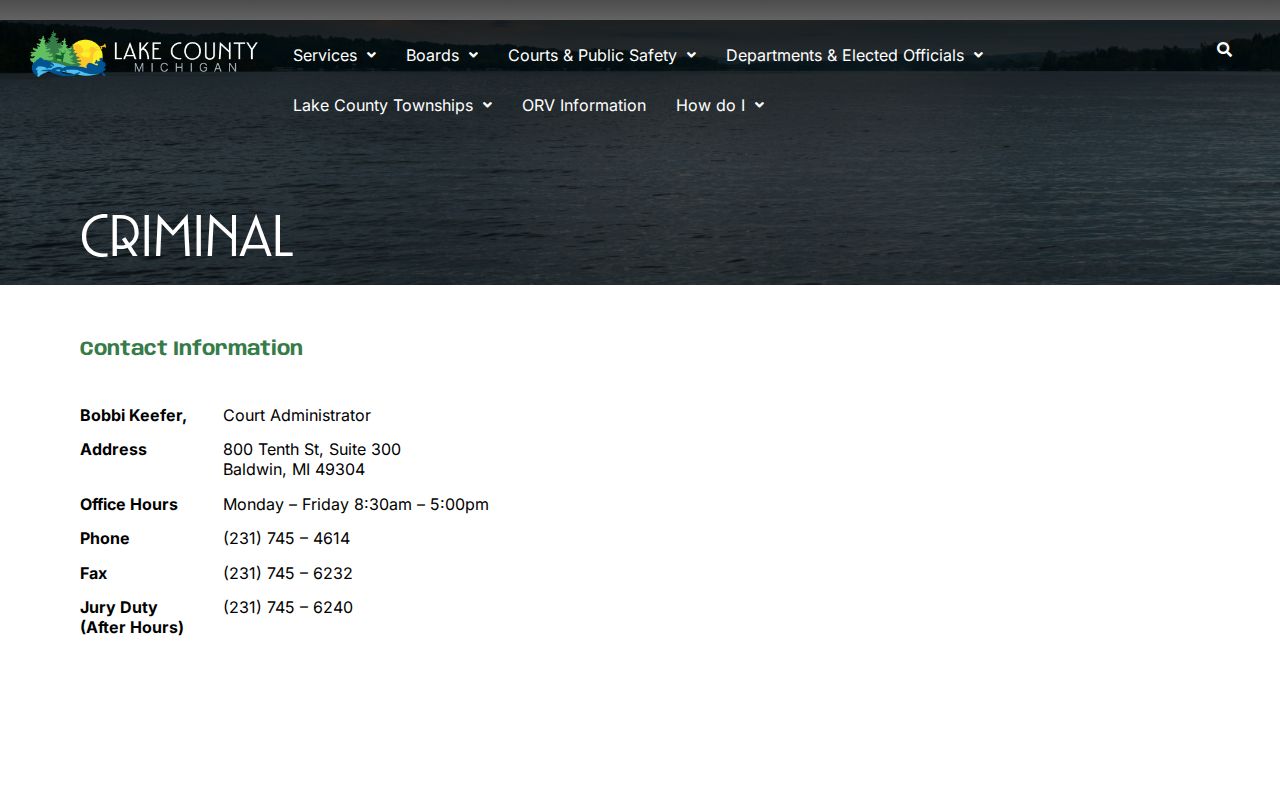
That counter handles district cases and the early stages of felonies before any bindover to Circuit Court.
One Sheriff Shapes Lake County Criminal Records
Lake County has just two incorporated municipalities, Baldwin and Luther, and both are villages. Neither has a police department, municipal court, or city lockup. That fact changes the normal city-record search. The Lake County Sheriff is the only local general police agency, Central Dispatch keeps countywide call data, and both villages use the jail and county trial courts in Baldwin.
Custody also follows the county route. A Baldwin or Luther arrest is booked at the Lake County Detention Center. If charges follow, a misdemeanor begins in the 79th District Court. A felony also starts there, then can move to the 51st Circuit Court. Village FOIA forms remain useful for village administrative and ordinance records, but they are not the place to request a sheriff incident report. This division saves a wasted request and points the reader to the office that created the record.
Lake County Trial Court
800 Tenth St., Suite 300
Baldwin, MI 49304
231-745-4614
Monday-Friday, 8:30 a.m.-5:00 p.m.
Lake County Sheriff
1153 Michigan Ave.
Baldwin, MI 49304
231-745-2712
Use county FOIA for agency reports.
Michigan Official Background Checks
The Michigan State Police Criminal Justice Information Center keeps the central repository. Its Internet Criminal History Access Tool, known as ICHAT, lets any public user run a name and date-of-birth search. The result covers public Michigan felonies and serious misdemeanors punishable by more than 93 days that were reported to MSP. It is not a full national or local file.
For a review of your own record, fingerprints provide a stronger identity match. MSP says the fingerprint product includes public and nonpublic Michigan data linked to the prints. A Lake County resident should call the sheriff first to confirm current fingerprint hours and any local capture cost. An FBI Identity History Summary is a separate subject-only process for federal repository data.
| Official product | Basis and scope | Price found |
|---|---|---|
| ICHAT | Name, birth date, and descriptors; public reportable Michigan history | $10 per search |
| MSP self-review | Fingerprints; public and nonpublic Michigan data tied to the prints | $30 |
| Set-aside processing | Fingerprints and application packet sent through MSP | $50; no juvenile processing fee |
| Lake court file | Name or case number; filed local cases | Local fee not located |
The MSP criminal-history overview is the source for the state repository limits and official self-review routes.
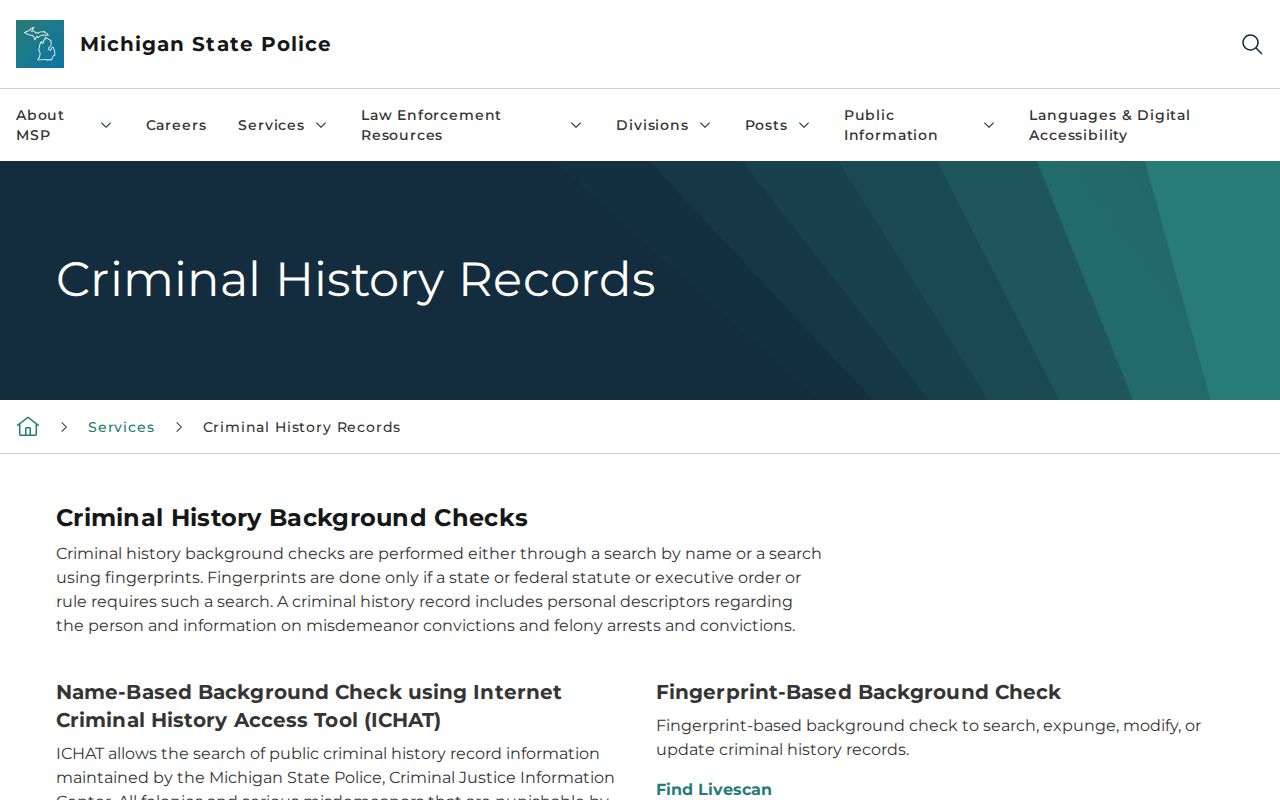
The state overview helps a Lake County reader choose between a quick public name search and a fingerprint-based personal review.
ICHAT Gaps in Lake County Criminal Records
A “no record” ICHAT result means no matching public Michigan entry within that product’s coverage. It does not prove that no arrest, case, or warrant exists. ICHAT omits suppressed records, warrants, juvenile matters, traffic records, tribal and federal matters, other-state records, and local misdemeanors. A name mismatch or reporting lag can also separate an arrest cycle from its disposition.
Use the fields with care. Search a legal first and last name with the date of birth, then use a middle name or initial, race, and sex to narrow a common-name result. Aliases can require a separate query. The fee applies to each paid search, so confirm spelling before checkout.
| ICHAT field | Required | Use |
|---|---|---|
| Last name | Yes | Accurate legal spelling matters. |
| First name | Yes | Use the legal first name. |
| Middle name or initial | No | Narrows common names. |
| Date of birth | Needed for a reliable match | Separates people with the same name. |
| Race and sex | Optional or unspecified | Descriptors can narrow identity. |
When a result and a Lake County judgment disagree, compare the certified disposition with the MSP entry. MSP provides a correction channel, and a court that cannot update the record electronically may use the RI-027 Judicial Correction Worksheet.
Criminal Record Types
Lake County criminal records are event-based, case-based, custody-based, or person-based. The producing agency controls what the record can prove. An officer’s report explains the event. A jail file documents intake. A court file tracks filed counts and rulings. MSP links reportable arrest and disposition data to a person’s identity.
- Incident and arrest report: the sheriff or another arresting agency records event facts, alleged offenses, and officer work.
- Booking record: the Lake County Detention Center records intake time, initial charges, bond, housing, and release data.
- Court case file: the 79th District or 51st Circuit Court records complaints, hearings, count outcomes, and sentence.
- State criminal history: MSP CJIC compiles reportable fingerprint arrest cycles and reported dispositions.
- Special-purpose record: warrants, OTIS supervision profiles, and PSOR entries each answer a narrower question.
These records can differ without one being false. An initial booking charge may be amended, dismissed, or replaced before judgment. The final result belongs in the court register, while the original arrest and booking events may remain in their source files.
Lake County Criminal Records Without Online Rosters
Lake County does not publish an official online jail roster or booking log. The county corrections page describes the facility, but it is not live custody data. For recent custody, call the jail at 231-745-6201. For a retained booking or custody record, submit the Lake County FOIA form. Search the district or circuit file for filed charges and bond orders.
A precise request works best. Identify the event date, location, report number, person’s name and birth date when needed, and the exact record type. The county form offers Public Record, Criminal History Record, Traffic Crash Report, and Incident Report choices. Conditional fields include the incident date and place, referred names, report number, delivery by mail or email, and up to three named people.
OTIS is not a replacement. It covers MDOC prisoners and qualifying parole or probation records, generally retaining discharged people for three years after supervision ends. It omits jail-only custody and unsentenced people. MI-VINE at 1-800-770-7657 supplies custody or release notice where covered.
Inside a Lake County Criminal Record
A Michigan criminal-history file centers on identity and arrest cycles. A Lake County court file centers on one case, while the booking file centers on custody. Reading the source label first prevents a charge from being mistaken for a conviction or a supervision record from being treated as a full history.
| Name & Identifiers | Legal name, aliases, birth date, descriptors, state ID, FBI number, and fingerprint transaction references where included. |
|---|---|
| Arrest / Booking Data | Arrest date, agency, report number, booking time, intake charge, bond, and release or transfer details. |
| Charges & Statutes | Count, offense description, Michigan statute cite, charge level, and later amendments. |
| Disposition | Pending, dismissed, acquitted, convicted by plea or verdict, or another count-specific outcome. |
| Sentence | Jail or prison term, probation, fines, costs, restitution, and other orders when public. |
| Custody / Supervision | County jail status or the narrower MDOC prison, parole, or felony-probation slice shown by OTIS. |
Several court terms matter in Lake County. They describe steps, not guilt by themselves.
- Register of actions
- The dated list of filings, hearings, orders, and case events.
- Bindover
- The move of a felony from District Court to Circuit Court after probable cause or waiver.
- Disposition
- The final outcome of a count, such as conviction, dismissal, or acquittal.
- Set aside
- Michigan’s statutory process that removes a qualifying conviction from the public record.
Lake County Criminal Cases Change Courts
A Lake County felony normally begins in the 79th District Court with the complaint, arraignment, probable-cause conference, and preliminary examination or waiver. If the matter is bound over, the 51st Circuit Court handles the information, motions, plea or trial, sentence, and later activity. Both courts use the shared Trial Court counter at 800 Tenth Street, Suite 300.
The record flow is: arrest or summons → District Court complaint → arraignment and bond → probable-cause stage → bindover → Circuit Court information → plea or trial → disposition and sentence. “Bound over” does not mean convicted. Search both court levels, because the district case can end at transfer while the final result sits under a different circuit case number.
The MiCOURT interface shows the search layer used to find participating trial-court cases.
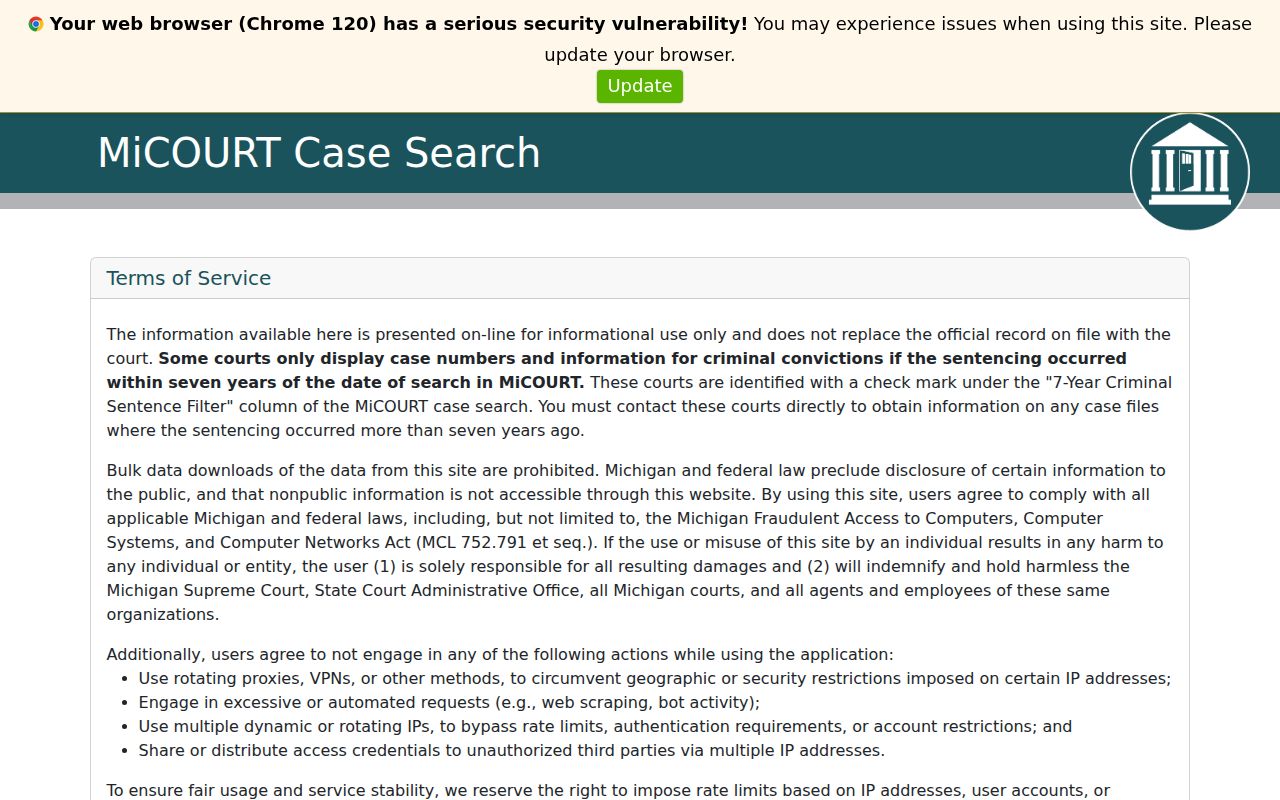
Online results are informational; the Lake County Trial Court supplies the official docket and any non-online public document.
Public Access Laws in Michigan
Access depends on the custodian. Michigan FOIA governs records held by local and state executive agencies, including releasable sheriff, jail, dispatch, and MSP material. Judicial case records use court access rules instead. Juvenile matters, victim details, protected identifiers, active investigative content, and security-sensitive material can be closed or redacted.
Key Michigan laws:
Michigan FOIA, MCL 15.231-15.246 makes public-body records open unless an exemption applies and sets request, fee, and response rules.
MCL 28.242 directs MSP’s collection and administration of Michigan criminal-history information.
Michigan Court Rule 8.119(H) permits inspection and copies of case records unless law, rule, or court order restricts them.
MCL 780.621 sets application-based conviction set-aside eligibility and exclusions.
MCL 780.622 defines the effect and continuing limits of a set-aside.
MCL 28.728 governs information made public through Michigan’s sex offender registry.
Lake County’s general FOIA response is due within five business days, with one extension of up to ten more business days. The response may grant, deny, partly grant, or extend. A denial explains the basis and appeal route.
Lake County Criminal Record Request Costs
The county does not publish a complete sheriff criminal-record fee list. Ask for a written itemized estimate before approving a large search, review, or video request. The Lake County FOIA policy does state its general cost rules. It uses the lowest-paid worker able to perform chargeable search, review, and redaction work, and it charges actual reasonable media and postage costs.
| FOIA cost item | Lake County rule |
|---|---|
| Letter or legal paper | $0.10 per sheet, with economical double-sided copying where practical |
| Postage | Actual economical cost |
| Search, review, and redaction | Lowest qualified wage; 15-minute increments rounded down when chargeable |
| Duplication labor | 10-minute increments rounded down |
| Digital media | Actual reasonable cost |
| Deposit | Up to half when the estimate exceeds $50 |
| Qualified indigency waiver | First $20, generally no more than twice per calendar year |
Electronic requests are treated as received one business day after transmission under the county policy. A narrow request by date, report number, office, and record type can reduce search time and avoid review of records that were not needed.
Sealed, Expunged, and Restricted Records
Michigan uses “set aside” as the statutory term, while state materials also say “expungement.” Juvenile matters, suppressed records, and protected identifiers do not appear in ordinary public searches. A set-aside changes public access, but it does not erase every authorized criminal-justice use or guarantee that every linked system updates at once.
Application-based relief is filed in the court of conviction. The waiting period runs from the latest of sentence, imprisonment, probation, or parole discharge. The cited Michigan rules use seven years when more than one felony is addressed, five years for one felony or a serious misdemeanor and certain first operating-while-intoxicated relief, and three years for eligible ordinary misdemeanors. Eligibility depends on the current offense statute and full record.
For a Lake County filing, obtain the certified judgment or register of actions from the Trial Court, complete the current state application, and obtain an RI-008 fingerprint card. Send the prints, certified record, application, and $50 MSP processing fee to CJIC as directed. MSP states an eight-week processing and mailing period. After an order, verify the court file, ICHAT, and a fingerprint self-review. Michigan Clean Slate also supplies automatic relief for eligible convictions, but it is not identical to the application process.
Lake County Criminal Warrants Without Web Lists
Lake County has no public active-warrant database. ICHAT leaves out warrants, and MiCOURT is not a real-time warrant-confirmation tool. A docket can show that a warrant was issued, but the status may have changed after recall, arraignment, bond, or a data correction.
- Call the Lake County Sheriff at 231-745-2712 and ask for the current verification method.
- Call the Trial Court at 231-745-4614 for a bench warrant tied to a known district or circuit case.
- Submit county FOIA for releasable warrant information, understanding that sealed or active-investigation details can be withheld.
- For a Baldwin or Luther ordinance matter or missed hearing, begin with the 79th District Court because neither village has a municipal court.
Do not rely on a stale third-party list or appear at an office based only on an old entry. Obtain current instructions from the sheriff, court, or counsel. An arrest warrant, bench warrant, search warrant, and out-of-county hold serve different purposes.
Lake County Criminal Records Across Recreation Lands
Lake County spans 567.59 square miles and had an estimated 13,182 residents in 2025. Its public-safety footprint grows with more than 300 miles of designated trails, 156 lakes, and 47 trout streams or rivers. An event on an ORV trail, state land, or waterway may produce a sheriff record, a Michigan DNR record, or an MSP record rather than a village file.
Use the arresting agency shown on the report or court file. A sheriff incident goes through Lake County FOIA. An MSP-created report goes through MSP FOIA. Conservation records belong with the DNR channel. Lake County crime data should be read under Sheriff ORI MI4314300 because Baldwin and Luther do not operate reporting police departments. Voluntary reporting gaps also make simple rankings risky.
The Census QuickFacts table for Lake County supplies the official demographic context.
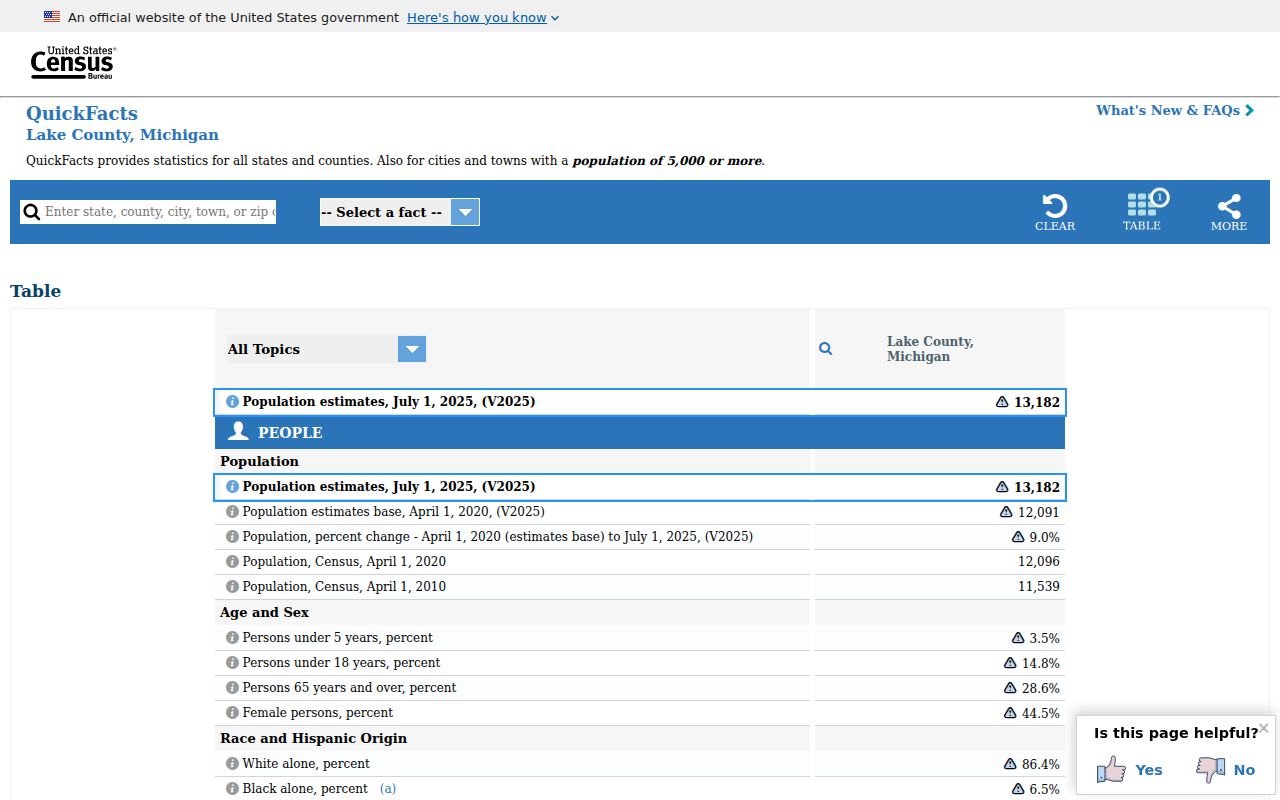
The county’s rural size, older population, and centralized Baldwin offices make phone, online, and mail access important parts of a complete record search.
Lake County Criminal Records by City
Baldwin and Luther are Lake County’s only incorporated places. Each village keeps its own administrative and ordinance records, but criminal records follow county channels. Sheriff patrol, Central Dispatch, the Detention Center, and the 79th District and 51st Circuit Courts serve both communities. The city guides keep that local routing clear without inventing a village police unit or municipal court.
Baldwin Criminal Records
Population 902 · Village records stay with Village Hall; police, booking, and court records use Lake County offices.
Luther Criminal Records
Population 332 · The sheriff serves Luther, and filed cases route to the county courts in Baldwin.